
The engineering
What you are paying for
The premise
The difference is engineering, not marketing.
Every lens in the CLIFF range starts the same way: as a disc of optical material with no prescription in it. What separates the tiers is what happens next — how much computation, measurement and machining stand between that blank and the lens in your frame.
How the range is builtRead less
At the entry of the range, the answer is a proven universal design, finished in advance and ready immediately. At the top, the answer is a design selected for how you actually use your eyes, calculated for your exact prescription and frame, and cut point by point rather than pressed from a stock tool. Neither is a trick. They are different amounts of engineering, at different prices, and this page shows you exactly where the difference lives.
From material to meaningful vision
Precision in every stage.
Scroll down through the six stages between a liquid and the lens in your frame.
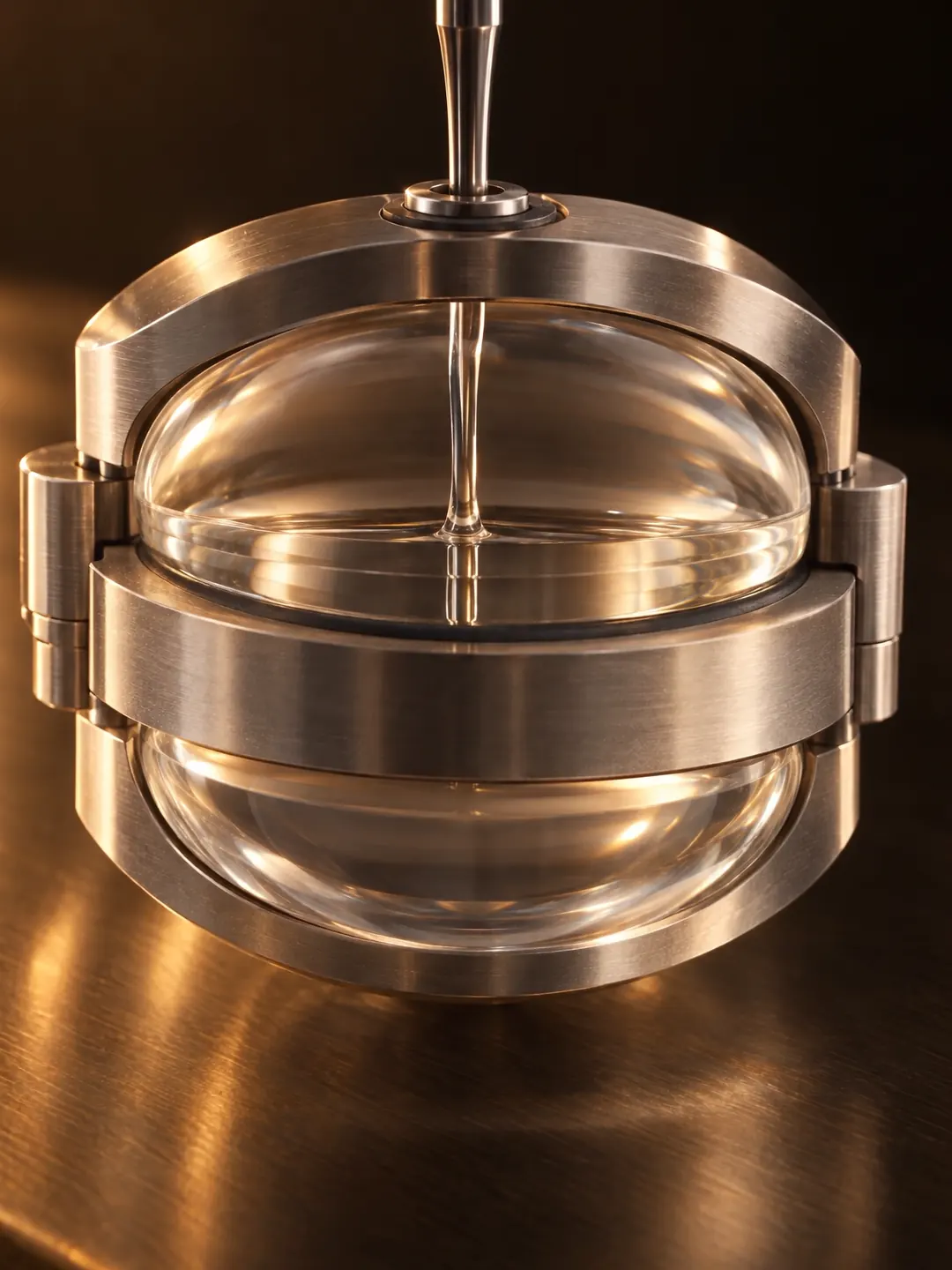
/ 06
Cast
Liquid monomer · optical mold
Liquid monomer is precisely filled into an optical mold.
Two mold halves, held apart by a gasket, set the lens's front curve and its thickness. The liquid goes in slowly and without bubbles, because anything trapped now stays inside the lens for its whole life.
What it means for you
Clarity starts in the material. Every later stage works on what the cast gets right.
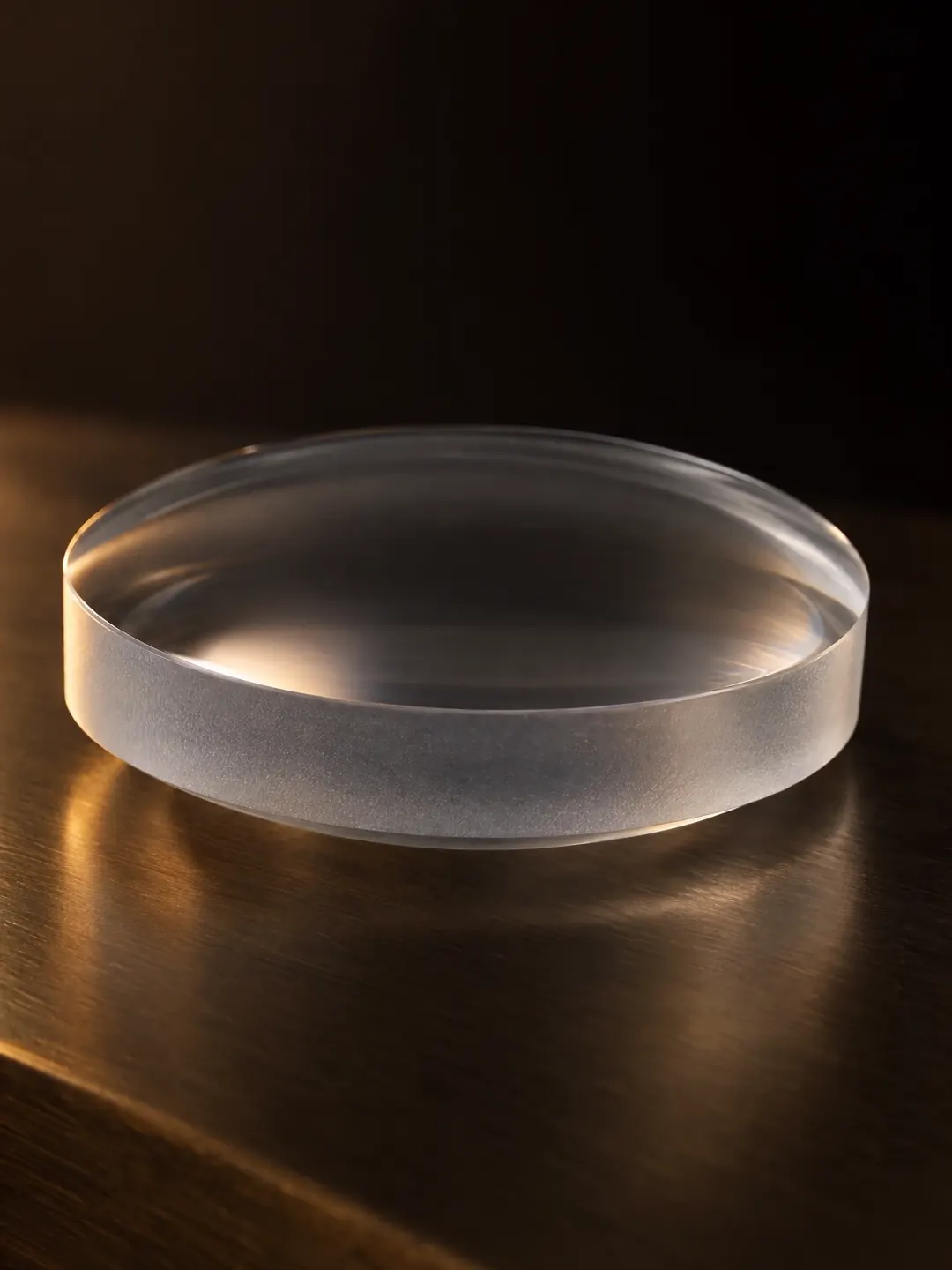
/ 06
Blank
Front finished · back left thick
The material is polymerized into a thick, clear lens blank.
A controlled cure turns the liquid into a solid, even blank. Its front surface is finished by the mold; its back is left deliberately thick — material waiting for one person's prescription.
What it means for you
The blank holds no prescription yet. Nothing about your lens has been decided in advance.

/ 06
Calculate
One surface map · one order
Your prescription and design are mapped onto the back surface.
Your prescription and the chosen design are computed into a surface map — thousands of points, each with its own height. From Zenn up, how your frame sits on your face is part of the calculation too.
What it means for you
This is where the lens becomes yours — before anything is cut.

/ 06
Surface
Back surface · every made-to-order lens
A diamond tool cuts the prescription and freeform design into the back surface.
The tool follows the map point by point, then the surface is polished without losing its shape. On every made-to-order CLIFF lens, the back surface carries both the prescription and the design.
What it means for you
Sharper vision away from the center of the lens, where molded lenses drift from your prescription.
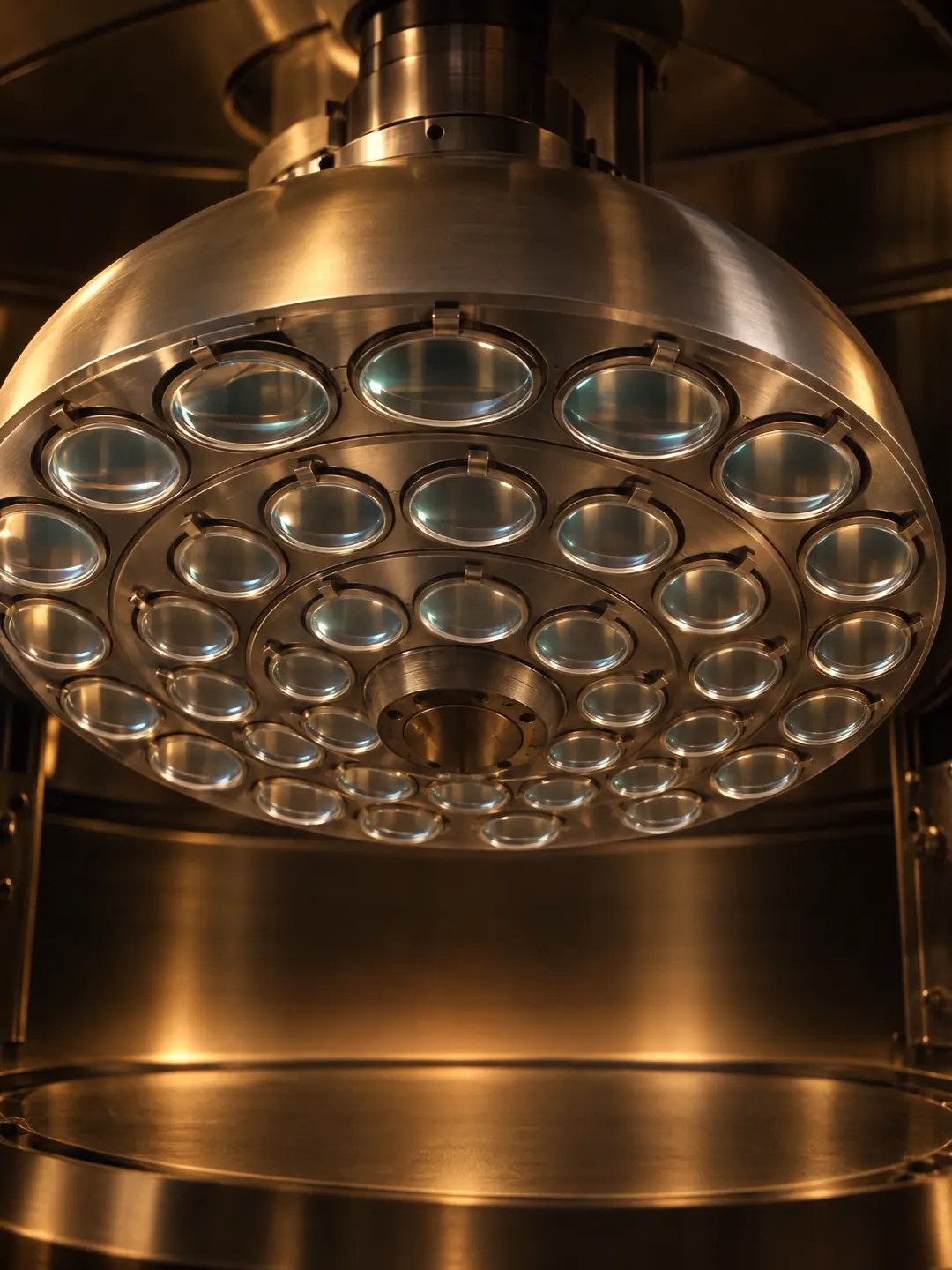
/ 06
Coating
UV protection to 400 nm · 12-month coating warranty
Anti-reflective layers are laid down in a vacuum chamber, over the hard coat.
A hard coat is cured on first, for scratch resistance. Then, in a vacuum, layers far thinner than a wavelength of light are deposited one over another, tuned so the reflections off them cancel out.
What it means for you
Fewer reflections between you and the world — and in every photo of you.

/ 06
Finish
Fitted by your optician
A finished lens — clear, precise, made for one prescription.
The lens is checked against its order, and your optician fits it to your frame. Every stock lens and every progressive lens carries the CLIFF mark — permanent, and readable under angled light.
What it means for you
One lens, made for one prescription and one frame — yours.


The ladder
The ladder: what each step adds
Every step up the range adds something the lens physically does differently.
The curves are illustrative — the shape of the principle, drawn from how each design is made, not measured data.
- Versatile
Where each design starts to drift from your prescription
Sharp through the center, falling away soonest toward the edge — a stock design is not compensated for your frame or the angle you look through it. Illustrative · the shape of the principle, not measured data
01 · Stock progressive
Versatile
One universal curveA stock lens, and deliberately outside the technology ladder: one universal progressive design, engineered once to fit the widest range of faces and made in advance. No calculation happens for your order — which is exactly why it is immediate and affordable. You give up personalization; you keep a proven design with no unknowns in it.
- Dynamix
- Versatile
Where each design starts to drift from your prescription
Freeform surfacing holds your prescription further from the center than a molded lens before clarity starts to fall. Illustrative · the shape of the principle, not measured data
02 · Everyday custom
Dynamix
+ freeform, cut point by pointThe value way into made-to-order CLIFF lenses. Every Dynamix lens is surfaced to your exact prescription — cut to order rather than pressed from a stock mold — an optimized design built for all-round everyday wear, at an honest price.
- Zenn
- Dynamix
- Versatile
Where each design starts to drift from your prescription
Edge-to-Edge Compensation corrects the lens point by point, so the prescription you receive near the edge stays close to the one at the center. Illustrative · the shape of the principle, not measured data
03 · Premium
Zenn
+ compensated to your eye, edge to edgeDesign intelligence on top of made-to-order machining. The optics are calculated for how light actually travels through the lens to your eye, edge to edge, and for how your frame sits on your face — the difference between a lens made to your prescription and one made for your eyes.
- Zenn AI
- Zenn
- Dynamix
- Versatile
Where each design starts to drift from your prescription
The same edge-to-edge correction, with the design itself chosen for how you use your eyes — the widest clear zones in the range. Illustrative · the shape of the principle, not measured data
04 · Most personalized
Zenn AI
+ the design itself is chosen for youThe intelligence moves up a level: not just how the design is calculated, but which design you get. In progressives, the lens is matched to how you actually use your eyes; in single vision, the configuration is chosen for your profile. The top of the range, because the starting point — the design itself — is individual.
Every claim, examined
The technologies, one by one
Freeform surfacing
A computer-controlled generator cuts your prescription directly into the lens surface in thousands of tiny steps, to a precision measured in hundredths of a diopter — rather than the lens being selected from a range of pre-molded curves.
Read moreRead less
You noticeSharper vision away from the center of the lens, where molded lenses drift from your true prescription.
Freeform is the machining, not the design — a well-machined mediocre design is still mediocre, which is why the design technologies matter. Freeform is on the back surface of every made-to-order lens — the surfacing and the design both.
Available in Every made-to-order CLIFF lens — Dynamix, Zenn and Zenn AI
Clarity
Illustrative · the shape of the principle, not measured data
Wear Fit
Two people with identical prescriptions wear the same frame differently: closer or farther from the eye, tilted more or less, wrapped more or less around the face. Each difference changes the effective power the eye receives. Wear Fit feeds the lens calculation with how the frame actually sits — so the optics are right as worn, not as measured flat in a lab.
Read moreRead less
You noticeThe lens performs the way your eye test promised, in your frame.
It is only as good as the measurements taken at dispensing — another reason CLIFF lenses are fitted by opticians, not sold in a pouch.
Available in Dynamix, Zenn and Zenn AI
Change in power at the eye (D)
| Lens-to-eye distance (mm) | −6.00 D | +6.00 D |
|---|---|---|
| 8 mm | −0.13 D | −0.16 D |
| 10 mm | −0.06 D | −0.08 D |
| 12 mm | 0.00 D | 0.00 D |
| 14 mm | +0.06 D | +0.08 D |
| 16 mm | +0.12 D | +0.17 D |
| 18 mm | +0.18 D | +0.26 D |
Worked example · standard optics, computed
Frame-shape thickness optimization
A lens is normally surfaced on a blank of standard diameter and curve and then edged down to fit the frame, so its thickness is decided by the blank and the material cut away at the edge was never doing any work. Frame-shape optimization takes the frame's four boxing measurements — A, the width; B, the depth; DBL, the bridge; and ED, the longest diagonal — and computes the thickness and the base curve for that shape before the surface is cut.
Read moreRead less
You noticeIn a strong plus or a complex prescription, where a standard lens is at its thickest, glasses that sit properly in the frame rather than standing proud of it — and a lens that is easier to get used to.
It is only as good as four frame numbers, and two of them are not printed anywhere. A and DBL are inside the temple arm; B and ED have to be measured or traced at dispensing. An order that arrives with the temple-arm code alone cannot be made this way.
Available in Dynamix, as the Dynamix Plus upgrade
Frame-shape thickness optimization −2.0 mm
| Surfaced diameter | Center thickness |
|---|---|
| 50 mm | 3.1 mm |
| 55 mm | 3.5 mm |
| 60 mm | 4.0 mm |
| 65 mm | 4.5 mm |
| 70 mm | 5.1 mm |
| 70 mm | 5.1 mm |
Worked example · standard optics, computed
AdaptEaseprogressive
Most people who abandon progressives abandon them in the first two weeks. AdaptEase is a design philosophy aimed at exactly that window: softer power transitions where new wearers struggle most, so the adaptation period is shorter and gentler.
Read moreRead less
You noticeThe first days feel manageable rather than alarming.
No design removes adaptation entirely — the brain still has to learn the lens, which is why the CLIFF adaptation program exists. Adapting to progressives
Available in Zenn and Zenn AI progressives
Illustrative · the shape of the principle, not measured data
Edge-to-Edge Compensation
Standard lens calculation assumes light passes through each point of the lens straight to your eye. It doesn't — rays from the edge of the lens reach your pupil at an angle, which distorts the power you actually receive. Edge-to-Edge Compensation traces the real path of light through every point of the lens to your rotating eye and adjusts the surface point by point to compensate.
Read moreRead less
You noticeThe prescription stays true across the lens — edges included — instead of only where you look straight ahead.
Compensation is calculated for realistic wearing geometry; an unusually fitted frame changes the geometry, which is why fitting measurements matter.
Available in Zenn and Zenn AI
Power error
Illustrative · the shape of the principle, not measured data
Smart Add
The modern working day happens between 40 cm and a meter — screens, not books. Smart Add tunes the lens surface for those screen distances, easing the focusing load where wearers actually spend their hours.
Read moreRead less
You noticeLess end-of-day strain in screen-heavy work.
It is a comfort optimization, not a cure for screen fatigue — blink rate and breaks still matter more than any lens. It works from the working distance your optician records: measure it, don't guess it. Blue light — what the research shows
Available in Zenn and Zenn AI
Focusing demand (D)
| Viewing distance (cm) | Focusing demand (D) |
|---|---|
| 25 | 4.00 |
| 40 | 2.50 |
| 100 | 1.00 |
| 200 | 0.50 |
Worked example · standard optics, computed
AI designprogressive
Instead of one universal progressive design, three AI-developed designs — each optimized for a different pattern of real eye use — and the one that matches your day becomes your lens. Because the design is chosen for a pattern of eye use rather than averaged across every wearer, the clear zones sit where that pattern needs them.
Read moreRead less
You noticeMore of the lens simply works, especially in the intermediate and near zones where universal designs ration space.
The match is made from how you describe your day — answer the lifestyle questions honestly at dispensing.
Available in Zenn AI progressive only
Illustrative · the shape of the principle, not measured data
AI selectionsingle vision
Your visual profile — prescription, how you use your eyes, your frame — decides which single-vision configuration is chosen from the supplier's design library for the order. The same selection as the progressive, applied to one distance.
Read moreRead less
You noticeA single vision lens whose starting point is your profile, not an average wearer.
The choice is only as good as the profile it starts from — the measurements and the answers about your day taken at dispensing.
Available in Zenn AI single vision only
Where you'll find it
Which design carries what.
● yes · — no
| Versatile | Dynamix | Zenn | Zenn AI | |
|---|---|---|---|---|
| Freeform surfacing | — | ● | ● | ● |
| Wear Fit | — | ● | ● | ● |
| Frame-shape thickness optimization | — | ● | — | — |
| AdaptEase progressive | — | — | ● | ● |
| Edge-to-Edge Compensation | — | — | ● | ● |
| Smart Add | — | — | ● | ● |
| AI design progressive | — | — | — | ● |
| AI selection single vision | — | — | — | ● |
Versatile is a stock design and sits outside this ladder: it is made in advance, so none of these are calculated for one order. That is the trade it makes, not a shortfall.
Engineering you can ask about
Every claim on this page has a basis your optician can explain, and the ones that are CLIFF's own reported figures are labeled as such. That is deliberate. A lens is not a gadget; it is a medical-grade optical instrument you wear every waking hour. You are entitled to know what the money buys.